
In our latest blogpost we thought we would try to highlight not just the importance of Wills and Lasting Powers of Attorney but also to point out the advantages of having such important documents. In addition, we will explain what happens in the cases where this kind of provision has not been made. Unfortunately, these cases are all too frequent.
Now we realise that we are not dealing with the most exciting subject matter, and it’s understandable that many people are reluctant to discuss these issues too, but you should address them head-on. Remember, it’s not just for your benefit, it’s for the future well-being and security of your family and loved ones that you should take action.
When should we take action, I hear you ask, when is the best time to prepare? There’s no right or wrong answer to that one, but none of us can see the future, so it’s sensible to make provision and put your affairs in order. In other words, do it now – there’s no time like the present!
What provisions should we make? Perhaps the easiest place to start is to get a Will. It need not be difficult. People often say to us that making a Will is a good idea, but they just haven’t got around to doing anything about it yet. We have never met anyone who said no, that’s rubbish, we don’t want anything to do with that! It’s getting around to doing it which is the problem – only you can do that. This is perhaps the reason that over half of the adult population has no Will. This creates a lot of problems for families – unnecessary problems, which can easily be avoided if a Will is in place.
If someone dies without a Will, they are said to have died intestate. The law then steps in with a set of rigid rules (the Intestacy Rules) which determine what happens and who gets what. There’s lots of information about intestacy online, so we’re not going to bore you by repeating the rules here. If you’d like to know the details, have a look at some of these websites. Between them they will provide you with as much or as little information as you wish:-
Intestacy – who inherits if someone dies without a will? – GOV.UK (www.gov.uk)
Intestacy rules – Which?
Who can inherit if there is no will – the rules of intestacy – Citizens Advice
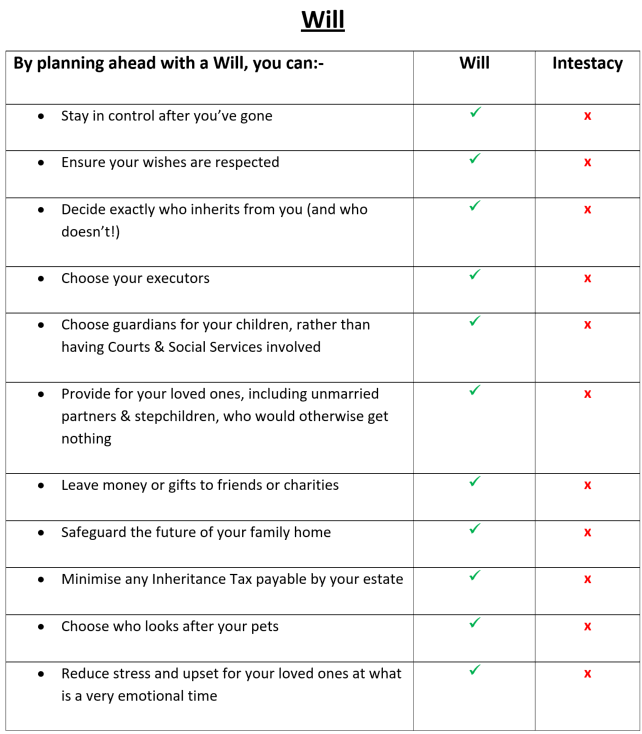
The message here is clear: Will = good; Intestacy = bad, so why not do something about it?
The table below sums up the differences by demonstrating the advantages of a Will. You can quickly see that intestacy can cause a lot of difficulties, which have to be sorted out by the bereaved family (as if losing a loved one isn’t bad enough). Lack of a valid Will just compounds the problems, and that’s the last thing you need in this situation.
When you’ve made your Will, what more can you do by way of getting your affairs in order? There is another step you can take, and that is to make a Lasting Power of Attorney. Unlike a Will (which is only effective after you’ve gone) a Lasting Power of Attorney or LPA is only valid during your lifetime. By signing an LPA, you appoint others (your Attorneys) to deal with your affairs and make decisions in your best interests. In this context an ‘attorney’ is someone you choose to act on your behalf, usually (but not always) when you have become incapable of dealing with your own affairs. It has nothing to do with a lawyer in an American courtroom drama! This incapability is often referred to as losing mental capacity. LPAs are becoming more relevant as more people live longer, and things like dementia, stroke and debilitating diseases are taken into account. A serious accident can also affect your ability to manage your affairs.
In these circumstances, many people assume that their spouse, partner or family can step in and sort things out – pay bills, deal with bank accounts, access your savings, make decisions about your medical treatment and care, etc. Unfortunately, these assumptions are wrong, and without an LPA in place, important decisions have to be referred to the Court of Protection. Applying to the Court is not a straightforward process, but it is an expensive one. Court fees for a new Application are currently £371.00. If the Court decides that a hearing is required, an extra fee of £494.00 is payable. These fees are payable to the Court. They do not cover the cost of any legal advice and assistance you may require. Most people would have difficulty conducting a Court application themselves, and would have to pay for legal advice in addition to the Court fees.
Such difficulties can be avoided with an LPA in place. We’re not saying an LPA takes away all the problems, but it goes a long way to making the whole thing easier to deal with if there is a loss of mental capacity.
Please be aware that there are two types of LPA. One deals with Property and Finance, the other deals with Health and Welfare. You can have either, or both. It’s sensible to have both to try and cover as many situations as possible. You can appoint different people to deal with your finances and your health issues. There are registration fees for each LPA you make and the current fee is £82.00 per document, which is a lot cheaper than the Court of Protection application fee. Registration is essential as the LPA cannot be used until it’s registered. For further details about the Court of Protection, and LPAs, you could have a look at these websites:-
Court of Protection – GOV.UK (www.gov.uk)
Court of Protection – Mind
Make, register or end a lasting power of attorney: Overview – GOV.UK (www.gov.uk)
Power of attorney – Lasting, enduring and ordinary – Age UK
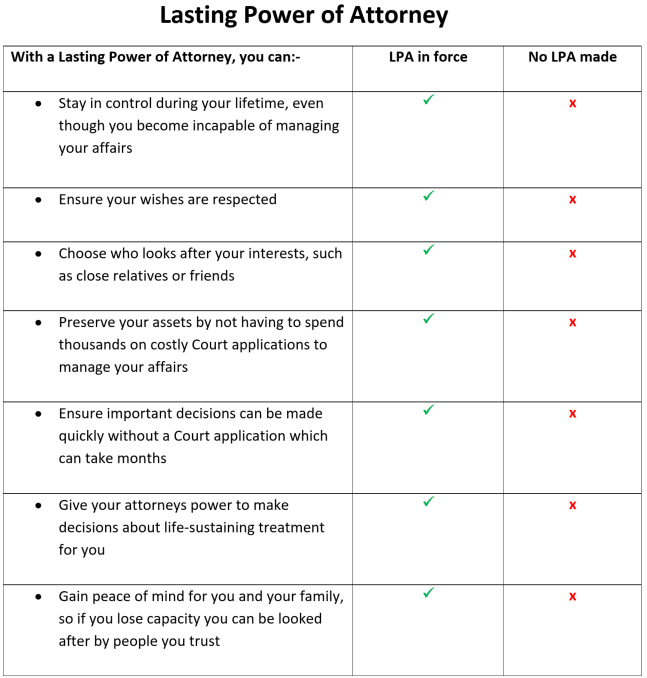
Have a look at the table below where we try to summarise the advantages of an LPA:-
We hope this article has highlighted the advantages of having both a Will and a Lasting Power of Attorney. Have a look at our website https://aberwills.co.uk for lots of free advice and information, or contact us on 07557 116317 or info@aberwills.co.uk to take action today.